
Beyond the Snapshot: Candidate Briefing of the Homeless Response System Report
On Thursday, July 9, Council for the Homeless (CFTH) welcomed more than 30 people running for local, state, and federal office for an in-depth briefing on our newly released 2025 Homeless Response System Report. As the lead agency coordinating homeless response efforts across Clark County, Wash., we brought those seeking or holding public office together to ensure they have a clear and accurate understanding of the realities of homelessness in our region, and the collaborative work being done to prevent and end it.
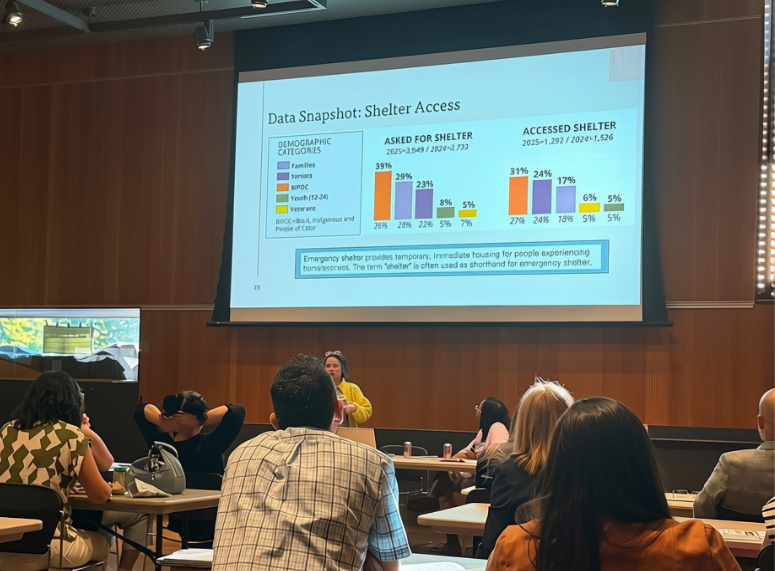
Candidates filled the Columbia Room at the downtown Vancouver Community Library for an evening of learning and candid discussion about the data that shapes our community’s response. CEO Sesany Fennie-Jones and COO Sunny Wonder led the presentation, offering a comprehensive look at the trends, challenges, and progress reflected in a full year of local homeless system data.
A Collaborative, Data-Driven Network
CFTH plays a central role in the homeless response system throughout Clark County with the management of Coordinated Entry, leadership of the Continuum of Care (CoC), and administration of the Homeless Management Information System (HMIS) database. Nearly five dozen partner agencies used HMIS throughout 2025 to input client data. This shared system allows service providers to assess needs and align clients to assistance programs and resources in multiple systems of care.
“It is also important to note that communities across the country input data into HMIS,” Sesany added. “Our data for Clark County is included in the overall picture of homelessness across the country.”
Snapshot vs. Full Picture: Understanding the Data
During the briefing, Sunny Wonder walked attendees through two major data sets: the annual Homeless Response System Report and the Point-In-Time (PIT) Count. She highlighted key differences between the two tools. The PIT Count, conducted annually in January, captures a one-day snapshot of people experiencing homelessness. Data for the PIT comes from outreach teams, school districts, food banks, and meal sites. It is widely known that the PIT Count does not illustrate a complete picture of homelessness in our community, as it is a one-day data snapshot of people experiencing homelessness — people with whom outreach teams were able to account for, connect with, and engage. In contrast, the year-long Homeless Response System Report reflects all data, entered into HMIS database by nearly 50 partners throughout 2025, offering a more complete picture of how many people accessed services, which needs were most urgent, and where system gaps persist.
What the 2025 Numbers Tell Us
The data from 2025 shows that more than 8,200 people experienced homelessness, 28% of which (or 2,300) included children. Our Housing Hotline, an essential access point for people seeking shelter and housing assistance, received more than 50,000 calls over the course of the year. These data points underline both the scale of local need and the ongoing pressure placed on the network of agencies working to support individuals and families in crisis.
Bridging the Gap Between Policy & Reality
The event offered candidates a valuable opportunity to ask questions, explore trends, and deepen their understanding of the coordinated strategies underway to reduce homelessness. With many candidates expressing a desire to make data-informed decisions, the briefing served as an essential bridge between the county’s homeless response system and the leaders who shape its future.
By sharing the 2025 findings with candidates, CFTH aims to strengthen collaboration and help ensure that policy discussions across our region are rooted in accurate information, lived experience, and shared goals. The challenges ahead require partnership across government, nonprofits, service providers, and the community. Events like this demonstrate that our community is committed to working together to build a more stable, connected, and hopeful future for all.
Learn more and review the full 2025 Homeless Response System Report by visiting councilforthehomeless.org/.
